
Monograph – Irritation of Life: The Subversive Melodrama of Michael Haneke, David Lynch and Lars von Trier
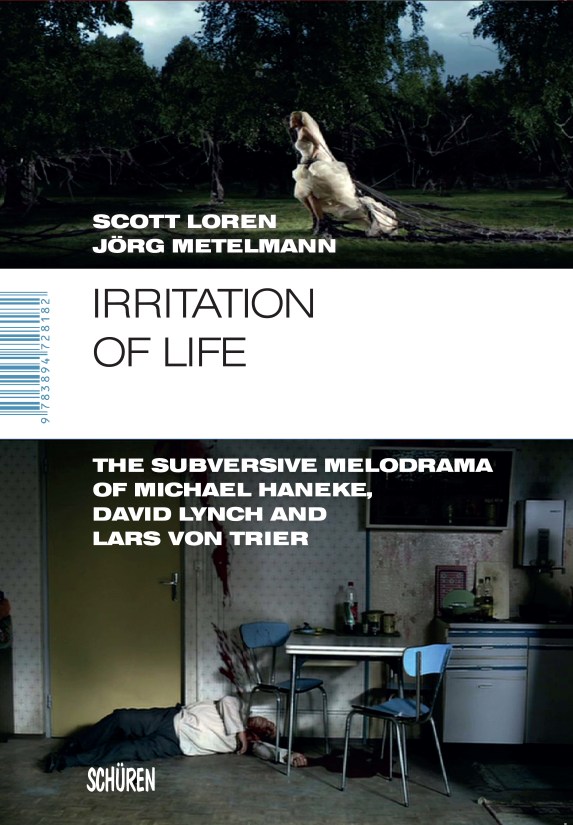
Irritation of Life explores the political and emotive potential of contemporary auteur cinema. Viewing the work of celebrated directors Michael Haneke, David Lynch and Lars von Trier through the film-historical lenses of melodrama and the avantgarde, Loren and Metelmann illustrate how convention and deviance interact to establish an aesthetics of irritation. If one is willing to play the game of participatory viewership such an aesthetics initiates, one cannot but enter into a series of negotiations in which habitual viewing practices and epistemological assumptions about the visual are dislodged. With melodrama as what Linda Williams has termed a body genre, not only are novel forms of cognitive experience at stake in subversive melodrama’s aesthetics of irritation, but also the invigoration of cinematic affect. Accordingly, the authors develop a strategy for interpreting filmic conventions and departure therefrom that integrates a phenomenological approach “through the senses” (Elsaesser/Hagener). Their densely illustrated readings of Haneke, Lynch and von Trier ultimately rehabilitate a question recurrent throughout the many discourses on melodrama and deviant aesthetics: what social impact might art forms like narrative film hope to achieve? This book suggests that subversive melodrama’s political work is characterized by processes of empathetic unsettlement (LaCapra), encouraging new perceptual cartographies in and beyond the cinema, or novel ways of seeing being. Exploration into these uncharted territories constitutes not an Imitation but an Irritation of Life.
Edited Volume – Melodrama after the Tears: New Perspectives on the Politics of Victimhood
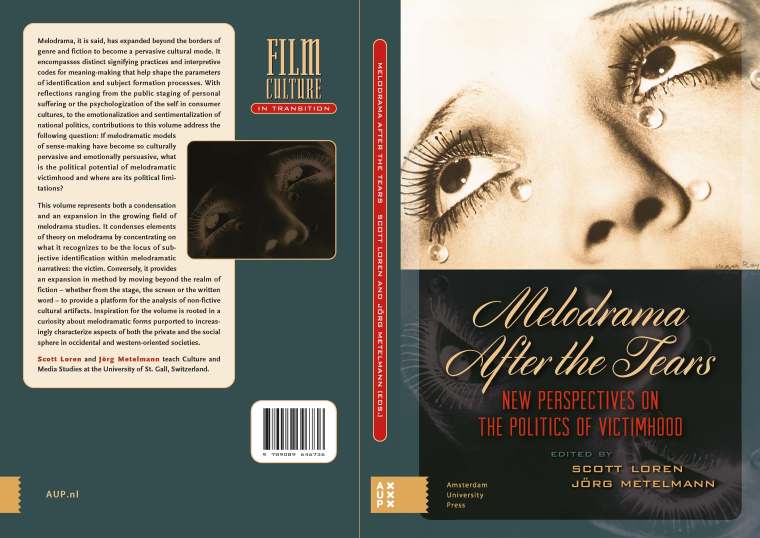
Melodrama, it is said, has expanded beyond the borders of genre and fiction to become a pervasive cultural mode. It encompasses distinct signifying practices and interpretive codes for meaning-making that help determine the parameters of identification and subject formation. From the public staging of personal suffering or the psychologization of the self in relation to consumer capitalism, to the emotionalization and sentimentalization of national politics, contributions to this volume address the following question: If melodramatic models of sense-making have become so culturally pervasive and emotionally persuasive, what is the political potential of melodramatic victimhood and where are its political limitations? This volume represents both a condensation and an expansion in the growing field of melodrama studies. It condenses elements of theory on melodrama by bringing into focus what it recognizes to be the locus for subjective identification within melodramatic narratives: the victim. On the other hand, it provides an expansion by going beyond the common methodology of primarily examining fictive works – be they from the stage, the screen or the written word – for their explicit or latent commentary on and connection to the historical contexts within which they are produced. Inspiration for the volume is rooted in a curiosity about melodramatic forms purported to increasingly characterize aspects of both the private and the social sphere in occidental and western-oriented societies.
International Conference – After the Tears: Victimhood and Subjectivity in the Melodramatic Mode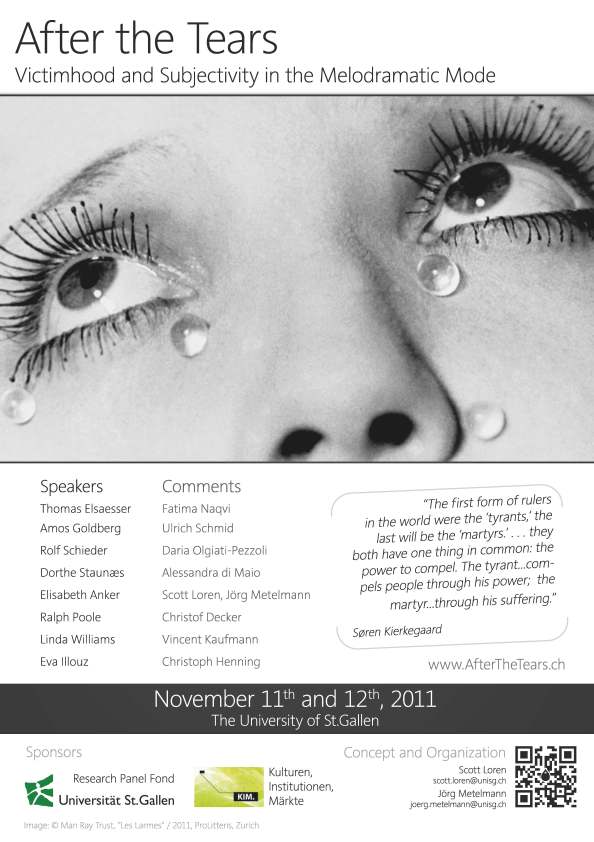
The spectrum of cultural artifacts evincing victimhood as a powerful ontological category in western societies continues to expand. Its capacity as a mode of legitimation, though, has been a source of much debate. This conference seeks new articulations of the political potential of victimhood in relation to the “affective turn” and the homo sentimentalis. It is particularly interested in the aesthetic practices and codes that are mobilized in various popular media to characterize the position of the victim, and whether an intervention in this form of popular subject formation could (or must?) itself take an aesthetic form.
SPEAKERS: Thomas Elsaesser, Amos Goldberg, Eva Illouz, Fatima Naqvi, Ralph Poole, Rolf Schieder, Dorthe Staunas, Linda Williams
COMMENTS: Timon Beyes, Christof Decker, Christoph Henning, Vincent Kaufmann, Scott Loren, Alessandra di Maio, Jörg Metelmann, Daria Olgiati-Pezzoli, Ulrich Schmid
ORGANIZATION: Scott Loren, Jörg Metelmann
 Postdigital lmaginaries